Search
    Google
    Tip of the Day Blog
    The Web
Thursday
Nov162006

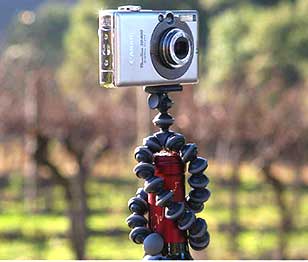
Gorillapod

http://www.kk.org/cooltools/archives/001485.php

gorillapod_sm.jpg

I am an amateur digital photographer. I have a full size tripod, but rarely used it. It was too big and bulky to take on hikes along with my 2-year-old daughter and all her stuff. I ordered the Joby Gorillapod. This tripod has legs that can be strongly wrapped around poles, branches, or ledges, and can fit in a small pouch or a large pants pocket. I liked that I had a environmentally friendly packaging free option. When it arrived I was surprised at its lightweight and small size. But surprisingly, it is amazing. Both my camera and DVR stay upright and stable on most any surface.

— Karl [Also recommended/reviewed by Fred Sobotka and Jeremy J.]

Joby Gorillapod
$25
Available from Joby

Also available from Amazon, $22

Wednesday
Nov152006

Digicams - Choosing a Compression Setting

Your digital camera probably provides a control for choosing the amount of compression that is applied to your images. Compression is, in a nutshell, simply a way of trimming some data out of an image file so that its file size is reduced.

Typically, compression settings are given the same vague monikers as resolution settings: Good/Better/Best or High/Normal/Basic, for example. Remember that these names refer not to the type or amount of compression being applied, but to the resulting image quality. If you set your camera to the Best setting, for example, the image is less compressed than if you choose the Good setting. Of course, the less you compress the image, the larger its file size, and the fewer images you can fit in the available camera memory.

Because all cameras provide different compression options, you need to consult your manual to find out what the options on your particular model do. Typically, you find a chart in the manual that indicates how many images you can fit into a certain amount of memory at different compression settings. But you need to experiment to find out exactly how each setting affects picture quality. Shoot the same image at several different compression settings to get an idea of how much damage you do to your pictures if you opt for a higher degree of compression. If you camera offers several capture resolution settings, do the “compression test” for each resolution setting.

As you choose your capture settings, remember that the pixel count and compression work in tandem to determine file size and image quality. Tons of pixels and minimum compression mean big files and maximum image quality. Few pixels and maximum compression mean tiny files and lesser image quality.

Source: dummies.com

Monday
Nov132006

Extended Warranties


The Word on Warranties: Don’t Bother

http://www.nytimes.com/2006/11/01/technology/circuits/01warr.html

By DAVID S. JOACHIM

IT may be tempting to buy extended warranties with all those high-tech gadgets on your holiday list, but the experts say they are almost always a waste of money.

The experts have done the math, taking into account the odds that a product will break, as well as the price of a warranty versus the cost of repair or replacement. In almost every instance, these warranties represent pure profit for the seller and pure loss for the buyer, they say.

“Extended warranties are basically overpriced insurance products,” said Andrew Housser, a co-creator and chief executive of Bills.com, a personal finance site. “At times it makes sense to buy insurance. It’s a good idea to buy home, car, life insurance. But those are priced in a very efficient marketplace.”

Because the insurance market is competitive and policies can be easily compared, insurance companies generally post profits in the 15 percent range, while electronics retailers generate margins as high as 80 percent on warranties, Mr. Housser said. That is a sign that the products they sell rarely break down during the warranty periods, making warranties a great deal for the seller but a bad deal for the buyer.

Indeed, Mr. Housser said, in many cases electronics retailers make almost no profit on the goods they sell; they make almost all of it on the sale of extended warranties. That may explain why salespeople put so much emphasis on warranties during their sales pitches, he and other experts say.

For years, Consumer Reports magazine has been telling its readers to stay away from extended warranties on most products, including cars, appliances and televisions, based on an analysis of repair records. Tod Marks, a senior editor, said the magazine’s surveys have found that warranties are an especially bad buy for items like computers, iPods, digital cameras and smartphones, mainly because prices for these products are always falling.

He calls a warranty on an item like this a “sucker’s bet.” “You’re betting that one, the product will break, and two, that it will break in the second or third year,” after a typical manufacturer’s warranty expires, Mr. Marks said. “And three, you’re betting that the cost of repair or replacement will exceed the cost of the warranty.”

For example, a recent Consumer Reports survey found that only about 10 percent of digital cameras broke during their first five years. For an extended warranty to be valuable, it would have to cost much less than 10 percent of the purchase price, since a camera with the same features will probably cost much less by the time you need a replacement. Yet a warranty on a digital camera usually costs 15 percent to 20 percent of the purchase price, Mr. Marks said.

The magazine’s surveys occasionally turn up examples of products that are better candidates for an extended warranty because of a high incidence of repairs. Early data on rear-projection television sets sold in 2005 and 2006 showed that 10 percent needed repairs (about three times the repair rate of picture tube and flat panel sets). Most repairs were bulb replacements, which cost about $400, including labor. So an extended warranty below that price might be worth it, Mr. Marks said.

But over all, extended warranties almost never pay for themselves. “If you’re someone who lies awake at night worrying, put that same money into a rainy-day repair fund,” Mr. Marks said. “Now you have the money to fix most problems. And if nothing breaks, go out to dinner and enjoy yourself.”

Risk aversion is a big reason why people keep buying warranties ­ totaling about $16 billion last year ­ despite the overwhelming evidence that they are a bad deal, said Amanda G. Nicholson, an assistant business professor at the Whitman School of Management at Syracuse University.

“They have become more prevalent as we are becoming less capable of fixing things ourselves,” Professor Nicholson said. “Most of us don’t know how any of this stuff works.”

So many people will pay just about any price for peace of mind, even when an item is so cheap it is practically disposable. Professor Nicholson recalled that a colleague spent $15 on a one-time-replacement warranty for a $35 portable CD player for her 14-year-old son, because he is known to break things. “You could drop it in the ocean and they would replace it, and guess what,” she said, “he dropped it in the ocean.”

Paradoxically, the people who are late in adopting new technology buy the bulk of the extended warranties, even though the products are less expensive and more reliable by the time they are buying, said Amar Cheema, a business professor at Washington University in St. Louis. He theorizes that these people are less comfortable with technology and thus more vulnerable to sales pitches for extended warranties.

“This is why you see them as an add-on cost that pops up after you have already made the commitment,” Professor Cheema said. “At the checkout, they say, ‘Hey, you just bought that for $900, pay just $150 for an extra two-year protection plan.’ ”

Buyers should be suspicious of these tactics, experts say, as well as offers to stretch out the price of a warranty over time, as part of a cellphone plan, for example. “From a budgeting perspective, $2 a month is nothing,” Professor Cheema said, “but if it’s $72 by the end of the period, it’s more than a new cellphone might cost.”

Mr. Housser of Bills.com says it is also worth noting that many retailers use third-party companies to honor extended warranties, and that can add red tape and time to a repair. “For them, any claim is a loss,” he said.

Of course, there is always the possibility that an expensive gadget will break, and you will wish you had bought the warranty. But experts agree that over many years of buying many products, saying no to extended warranties will save you bundles of cash.
Friday
Nov102006

Phishing

Phishing


Phishing is, in my opinion, the biggest risk we all face Online.  The deceptions used are very sophisticated.  There is one simple rule for avoiding getting hooked: NEVER enter your password in a website that you were directed to by a link in an unsolicited email.  This is particularly true for banking sites, Paypal and eBay.  I receive 1-2 phishing emails every single day.  Educate yourself and don’t be a victim.

I have mentioned phishing three times before on the TOTD:

http://totd.squarespace.com/tip-of-the-day-blog/2004/9/7/more-on-phishing.html

http://totd.squarespace.com/tip-of-the-day-blog/2004/4/12/phishing.html

http://totd.squarespace.com/tip-of-the-day-blog/2005/12/8/7-in-10-americans-fall-prey-to-phishing-scams.html

Although fewer attacks are successful, the losses per successful attack are growing.

Consumers to Lose $2.8 Billion to Phishers in 2006

http://www.pcworld.com/article/id,127799/article.html#

Robert McMillan, IDG News Service

Thursday, November 09, 2006 07:00 AM PST

Browser makers may have added new antiphishing features to their products in recent months, but the criminals are still gaining ground in their efforts to defraud U.S. consumers, according to the Gartner research firm.

Phishers have hit more victims with their online attacks, and while fewer people are losing money to phishers, successful attempts have been yielding bigger payoffs, said Avivah Litan, vice president and distinguished analyst at Gartner. “When they do succeeded, they’re stealing five times more than they stole last year.”

Phishers Get Big Payoffs

The average loss per phishing attack was $1244 this year, Litan said, up from $256. Gartner estimates that the total financial losses attributable to phishing will total $2.8 billion this year.

And users who are taken in by phishing scams are less likely to recover their money, Litan said. In 2005, 80 percent of victims got their money back. This year, that number dropped to 54 percent.

Gartner estimates that 3.5 million Americans will give up sensitive information to phishers in 2006—up from an estimated 1.9 million last year.

Antiphishing Efforts Playing Catch-Up

Although the recently released Internet Explorer 7 and Firefox 2.0 browsers came with new antiphishing features, Microsoft and Mozilla are still playing catch-up with the crooks.

“It’s still too early to know how effective [these new antiphishing features] are, but certainly that technology is a couple of years too late,” Litan said.

Phishing filters are not working because attackers are moving around their phishing Web sites and making it very difficult for antiphishing tools to tell the difference between a computer that is malicious and one that is simply unknown, she said.

A year ago, the average lifespan of a phisher’s Web site was one week. Now it’s just a few hours. “In the next year or two it will probably be one server per e-mail,” Litan said. “They’re impossible to catch and take down.”

A Failure to Communicate

Antiphishing expert Paul Laudanski agrees that these attacks are on the rise. Part of the problem, he says, is the fact that Internet service providers and the companies being spoofed by phishers are not doing all they could to share information and track down the criminals.

Often companies are reluctant to share information for fear that it may lead to lawsuits, said Laudanski, owner of Computer Cops and the leader of the Phishing Incident Reporting and Termination squad project.

“What we need, I believe, is free, open communication,” he said. “The criminals are working together in this, but it’s hard for us to work together.”
Monday
Nov062006

iPod Buyers’ Guide 2007

The guide is 180 pages all about the iPod, from the actual players, to accessories, history, reviews and more. It is definitely worth checking out for any current or future iPod owners.